
The Origins of Palm Springs Architecture & Design
Palm Springs, the popular desert destination in Southern California’s Coachella Valley, had an outsized influence on midcentury modern (MCM) architecture and design. Palm Springs’ distinctive Desert Modern architecture and interior design echo the natural desert landscapes of the region. Primarily low and horizontal in orientation, their shapes echo the mesas of the Southwest. Rock-covered mountains form a dramatic backdrop to low-slung houses. Boulders and desert botanicals like cacti and aloes add rough and spiky accents to the flat smoothness of the homes. Soaring above many homes one sees pairs of sky-piercingly tall palm trees. Palm Springs architecture shows itself off impressively by drawing the eye upward using these slim, impossibly tall palms. They help us stand back and view the low horizontal homes as part of a greater, grander, natural whole.
Palm Springs Architecture’s Desert-Inspired Innovations
Palm Springs architecture has even inspired its own particular MCM-related genre, Desert Modern design. Desert Modern homes’ interiors and exteriors tend toward soft colors, organic materials, and natural textures. Though often boxy and simple in shape, their proportions are sophisticated and pleasing to the eye. They also incorporate practical, structural innovations such as huge picture windows that erase visual boundaries between outside and inside, and large poured concrete patios made for outdoor dining, play, and swimming. Well-placed pergolas, breeze blocks, and thin horizontal or vertical exterior slats create shade and privacy while still allowing for generous open spaces and large numbers of windows. Palm Springs architects’ choices of materials, fabrications, shapes, and colors also reflect Palm Springs culture, which tends toward relaxed home entertaining and indoor/outdoor living.
Palm Springs architecture uses some traditional outdoor elements in untraditional ways. Examples include boulders or rough walls covered in large rocks or stones brought right inside the house. Open-plan interiors and built-in furniture, some hung from or built into walls, leave plentiful open floor space. These once-innovative layout choices are ideal for many families with small children, or for people who do a lot of indoor/outdoor entertaining.
For detailed examples and photos of Palm Springs’ Desert Modern decorating style, see my article Desert Modern Design.
Early Modernist Architects in Palm Springs
Some of the first major architects to design homes in Palm Springs were Europeans such as Richard Neutra, whose designs reflected austere, minimalist European modernism. They were inspired by the functional, boxy minimalism of 1920s and 1930s superstar architects like Walter Gropius and Le Corbusier. By the late 1940s, many of the architects who designed homes for newcomers to Palm Springs were U.S.-born. They brought the region’s special architectural, cultural, and climatological needs into consideration.
The architects of the post-World War II period often worked in a North American architectural vernacular. Their houses spread horizontally to take advantage of the plentiful suburban open lands. This often differed from the smaller architectural footprints of modernist urban spaces in long-established East Coast and European cities.
Some architects who moved to Palm Springs from the Midwest were followers of Frank Lloyd Wright, who was himself the designer of a number of West Coast and Southwestern buildings. They carried with them Wright’s Usonian love of function, use of natural regional materials, and desire to blend into nature.
Many began as architects in Los Angeles. They brought an urban viewpoint, but were aware of the needs of people who wanted vacation getaway homes in hot, dry desert climates. Numerous Palm Springs architects had first worked with celebrity clients in the film or music business in Los Angeles, and were used to large budgets—and a taste for architectural and dramatic novelty.

Architects of Palm Springs’ Heyday
From the 1940s to the late 1960s, major architects flocked to Palm Springs. There they designed aesthetically and functionally innovative buildings in the dramatic natural setting. Palm Springs seemed an ideal proving ground for their novel techniques and technologies. Sunny and beautiful year-round, Palm Springs set the scene with dramatic mountains, sky-high palm trees, and curvy, photogenic cacti. It was an alluring locale for moneyed celebrities who liked visual drama and wanted attention for their cutting-edge holiday homes. These homes provided convenient getaways away from the bustle of Hollywood—but not too far away.
Rich people who liked getting noticed sought out trend-setting architects such as Albert Frey, E. Stewart Williams, Hugh Kaptur, John Lautner, and William Pereira. They were willing to experiment with new forms of Palm Springs architecture that felt fresh and innovative, and perfect for casual indoor/outdoor living. Both clients and architects wanted to establish a style that felt fresh and dynamic, but relaxed enough for weekend entertaining. Some homes were grand mansions with astonishing views. But many were surprisingly modest in scale.

These chic new homes felt like accessible, achievable models of carefree, indoor/outdoor, open-plan modern living. Their style appealed to young Baby Boomer families across the country. As a result, Palm Springs style grew to have outsized influence in both architectural and interior design circles. By the 1950s, this mid-sized desert city had become a big player in the annals of midcentury modernism.
Swimming Pools and Movie Stars
Hollywood and Beverly Hills come to mind when we think of glamorous 20th century movie stars and popular musicians. But Palm Springs became a favored retreat for hundreds of A-list celebrities starting as early as the late 1920s and early 1930s. Over the following 40 years, its design influence grew ever stronger. Not only architects but set designers and interior designers did a brisk business creating elegant home interiors in Palm Springs. Designers like the great William “Billy” Haines (the former actor who became a major interior designer best known for the Hollywood Regency style) found great success in the desert. A number of people known today for their innovative Palm Springs architecture were actually primarily based elsewhere.
So why did celebrities flock to Palm Springs in the first place?
The desert city sprang into prominence among Hollywood movie stars largely because of the “two-hour rule.” From the 1930s to 1950s, studios insisted that actors stay within a two-hour drive of Los Angeles while working on movies. That way, actors could show up on short notice for reshoots or promotions. Just as important was the ability of handlers, whose job was to hide the stars’ naughtiest behavior, to keep a watchful eye on wayward celebs and keep their peccadilloes out of the papers.
Early Palm Springs Glamour
Palm Springs, incorporated as a city in 1938, was just under two hours from Los Angeles. The desert town’s natural hot springs were great for relaxation and provided health benefits. Its location near Hollywood, and its health-resort infrastructure, made it an ideal weekend destination for actors. Many drove to the desert to enjoy dips in hot springs, and forbidden trysts in fancy resort hotels, or at celebrity friends’ hideouts.
In the 1930s, Palm Springs began attracting big-name stars like Bing Crosby, Cary Grant, and Judy Garland. These luminaries started building private homes in new neighborhoods like the Movie Colony. Movie moguls like Samuel Goldwyn and Walt Disney did as well. Seeing new avenues for plying their trades, Hollywood set designers and decorators followed the movie folk and set up shop in the desert.
The Origins of Palm Springs

In the early 20th century, before the rise of Hollywood, Coachella Valley was known for rustic Old West charm. It grew from health retreats that developed around the region’s natural hot springs. Dry air, winter warmth, and sunshine were touted as curatives, especially for bronchial diseases. But while Palm Springs drew tourists reliably in cooler months, visitor numbers plummeted during blistering summer months. That’s when Palm Springs’ temperatures often rise to 110 °F, and sometimes soar above 120°F. However, by the 1920s—when air conditioning was just becoming popular in large-scale buildings like U.S. movie theaters and department stores—technological and architectural improvements made year-round desert living more comfortable. This was especially true for the moneyed classes.
By 1927, the grandeur and luxury of the El Mirador Resort attracted movie stars to the area. Palm Springs had plentiful open land for swimming pools, golf clubs, tennis, and other outdoor attractions. Other hotels and mansions followed suit, as did nightclubs and casinos. Beautiful new homes popped up, too. The Warm Sands, The Mesa, and the Historic Tennis Club neighborhoods appeared, featuring secluded private homes for private weekend trysts.
Many of Palm Springs’ early moneyed homeowners decorated in an elegant version of a Hacienda or Spanish Ranch style. This was associated with Southern California glamour as least as far back as the 1920s. Indeed, that style coexisted in Palm Springs alongside the more sleek and spare MCM style for decades. In 1957, celebrity costume designer Edith Head—winner of eight Oscars—built her home in Palm Springs. She chose to live in a Spanish-style villa with rustic wooden beams, arched doorways, plentiful red brick, and Saltillo tilework. The overall effect of such homes is moodier, heavier, and more rustic than today’s lighter, brighter Desert Modern style.
The Rise of Desert Modernism

Compared to many of the boldly colored and decorated midcentury homes found in vintage magazine ads, today’s Desert Modernist home interiors are (like their exteriors) largely pale, sunbleached, and elegantly subdued. They tend to follow the aesthetics and goals of the architects who designed them. These homes let location, regional materials, and local climate and culture dictate their design, inside and out. Those who follow Desert Modern style principles don’t fight with the natural setting, its colors, or its forms. They seek harmony and taste above all.
Frank Sinatra & the Architectural Avant-Garde

Many architectural historians date Palm Springs’ turn toward midcentury modernism to 1947. That’s when singer and actor Frank Sinatra decided he wanted a home to celebrate his massive career successes in style. At first, Sinatra asked architect E. Stewart Williams for a Georgian-style mansion. Williams hoped to put Palm Springs architecture on the map by designing something more innovative and contemporary. He convinced Sinatra to try something more contemporary and better suited to the desert surroundings. The result was Twin Palms, a 4,500-square-foot mansion with low, rectangular wings, a flat roof, and a large circular driveway.
Twin Palms was named for the regal palms that loom over the house. It also included a piano-shaped swimming pool and huge sliding glass doors to the backyard. These features supported the Sinatra family’s free and easy indoor/outdoor lifestyle. The house also included technological advances like a state-of-the-art stereo system and a home recording studio.
When the Structure & Setting Are the Stars
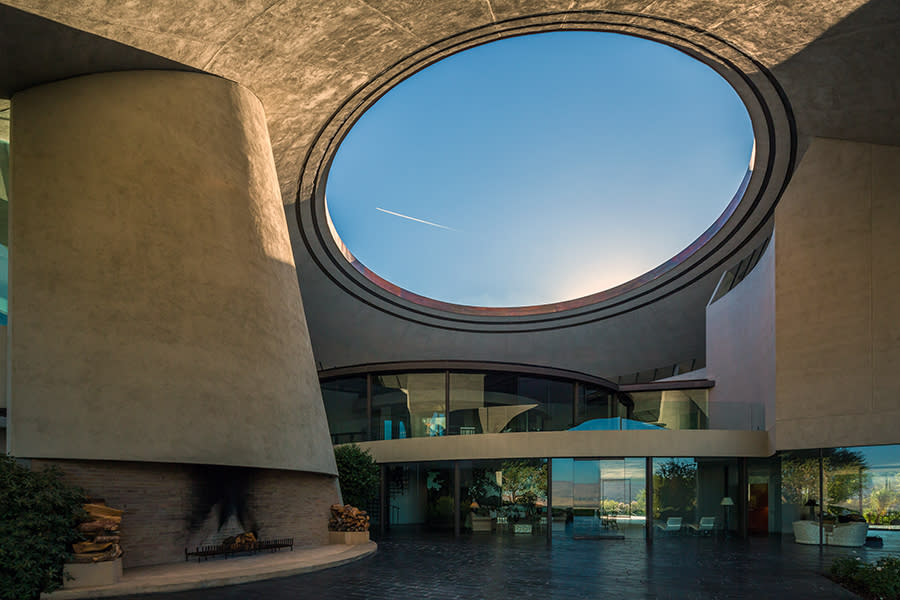
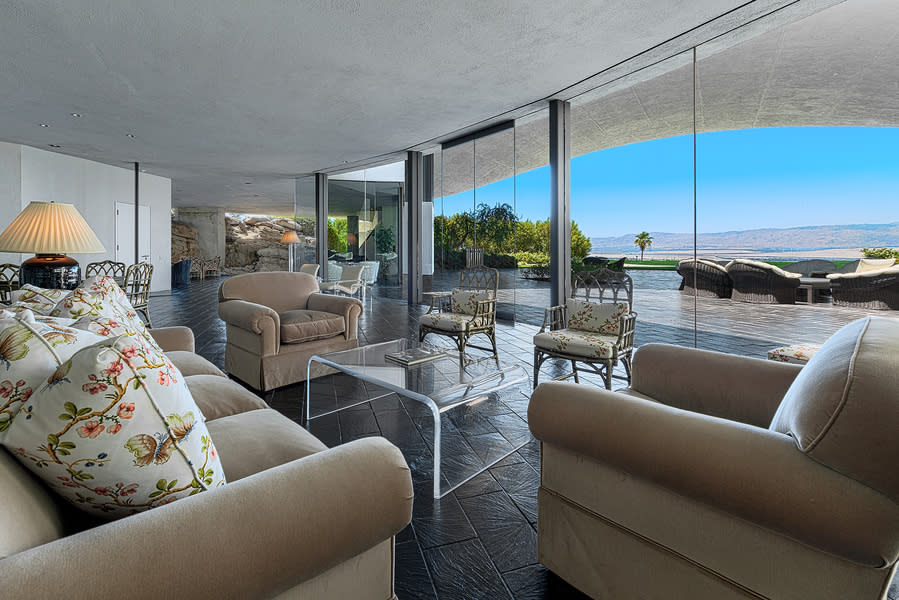
Because of its relative subtlety and emphasis on reflecting its setting, Desert Modern style has often been the choice of wealthy Palm Springs residents whose focus is on innovative architecture and impressive natural settings. For example, comedian Bob Hope’s enormous, iconic Palm Springs home was begun in 1973 and completed in 1979. It was designed by architect John Lautner, one of Frank Lloyd Wright’s protégés. The 23,000-square-foot concrete, steel, and glass structure has a dramaticand enormous open oculus (circular opening) in the ceiling, and a huge curved roof. Surrounded by rocky cliffs, the home affords spectacular views.
Because of Hope’s immense wealth (gathered from savvy real estate investments as well as a major career in entertainment) and the home’s dramatic architecture, one might expect the furnishings to be lavish and dramatic, too. But Bob and Dolores Hope’s goal was to furnish their home in a way that complemented the setting, the structure, and the views. The home’s neutral beige Desert Modern furnishings were comfortable and tasteful, but nothing special. They were chosen to allow the setting and architecture to take center stage.
A Special Brand of West Coast Modernism

West Coast Modernism is a distinctive regional architectural style. It centers on central-to-northerly West Coast cities such as Vancouver, Seattle, Portland, and San Francisco. Rather than adopting universal design principles, this style focuses on a home’s regional context. Considerations include surrounding landscape, climate, materials, and local culture and lifestyle.
On the East Coast, MCM homes took their cues from theoretical architectural principles established by European modernist architects of the 1920s and 1930s. These homes’ interiors didn’t necessarily reflect what was going on outside them. West Coast Modern style, on the other hand, considered setting, local weather and climate, and organic materials and color palettes. Bridging the interior and outdoor by making spaces that extended living space from inside to outside was important on the West Coast. States along the Pacific Ocean have a generally milder climate than those on the Atlantic, which allows West Coasters more days of indoor/outdoor living each year.
Desert Modernism took important cues from West Coast Modernism. It applied minimalist European modernist principles to architecture, but softened them by taking regional materials, climate, and lifestyles into consideration. But while more northerly West Coast regions had more variable climates, Palm Springs stayed hot and dry all year round. Desert dwellers figured out ways to turn shade, well-channeled air flow, and traditional regional materials into their secret weapons against extreme heat.
Palm Springs’ dramatic landscape provided rough and exciting natural forms like boulders, cacti, jagged mountains, and endlessly tall palm trees. These elements added plentiful natural textural interest, and the sweeping vertical and diagonal lines of trees and mountains especially set off the seemingly endless sea of white, low-slung, horizontal homes. More than any other style, Desert Modernism takes Palm Springs’ dramatic and specific setting into account.
Modernism Week: Palm Spring’s Major Design Events

Every February and October, Palm Springs hosts major celebrations of their midcentury modern roots. Modernism Week and Modernism Week — October are extravganzas of MCM design, architecture, art, fashion, and culture that include hundreds of events. These include home tours, lectures, parties, and popular walking tours. Most Palm Springs architecture tours don’t include interior visits, but even visits to see home exteriors can be fun and fascinating.
If you’re planning on visiting during one of these weeks, do schedule your trip as early as you can. Events often sell out months in advance. They can also be surprisingly expensive. A single hour-long visit inside a Palm Springs midcentury house can cost $75 or more. Multi-house tours can run into the hundreds of dollars. I considered taking a 90-minute tour that included brief stops in three houses for about $140 per person; it was already sold out well before Modern Week. Even at those prices, tours book become fully booked early.
If you’re a fan of MCM gardens and home exteriors, you can have a lot of fun driving through Palm Springs’ central residential neighborhoods and viewing hundreds of vintage MCM homes and gardens for free.
At top:
Superstar architect Richard Neutra’s boxy, minimalist Kaufmann Desert House, 1946, shows the influence of 1930s European modernist architectural principles. However, Austrian-born Neutra departed from strict European style. Instead, he was one of the architects resonsible for developing a new style incorporating Palm Springs-specific materials and geography in a desert setting—a prototype of Desert Modern Style | Public domain: Carol M. Highsmith Archive, Library of Congress